Showing posts with label teacherinquiry. Show all posts

Monday, August 25, 2025

Teacher Inquiry - Reading Comprehension

This term, my teaching inquiry continues to focus on improving reading comprehension for my Year 7 and 8 students. Following a recent lesson where I used Vosaic to record and reflect on my teaching, I've gained some valuable insights into what's working and where I can grow.

The Vosaic analysis highlighted several effective strategies. The most impactful was the explicit use of clear learning intentions at the start of the lesson, which helped students understand the goals of the session. The use of sentence frames like, "The text says... so I can infer..." provided a useful scaffold for students to articulate their thoughts and apply inference skills. I also saw the value of collaborative learning, as encouraging students to work in pairs to discuss vocabulary meanings fostered deeper understanding through peer discussion and accountability.

The feedback from the video also pointed out some areas for improvement. There were moments of off-task behavior and distraction during reading activities, suggesting a need for better classroom management to keep students focused. While I introduced new vocabulary, I could have provided more context and examples to enhance understanding. A key insight was the need to give more constructive feedback on students' inferences, which is essential for refining their thinking and moving their learning forward.

Looking ahead, my next steps will be to incorporate the following strategies, all of which are grounded in educational research:

  • Implement more student-led discussions: The analysis suggests that providing students with more opportunities to lead discussions can foster deeper understanding and greater ownership of their learning. Research by John Hattie (2009) supports this, indicating that student engagement is crucial for learning, and students become their own teachers when they are involved in their own learning process.

  • Utilise interactive technology tools: The report recommends using technology to increase student motivation and participation, particularly for interactive vocabulary exercises. This aligns with research from Baker et al. (2010), which shows that integrating technology into the classroom can boost student motivation.

  • Integrate formative assessments: The video analysis noted that a key to improving learning outcomes is to use formative assessments to gauge understanding and adjust instruction. This is a central idea in the work of Paul Black and Dylan Wiliam (1998), who found that innovations focused on frequent feedback can lead to substantial learning gains.

Wednesday, March 12, 2025

Teacher Inquiry - 2025

**I have since changed my Teacher Inquiry for 2025.

Will the use of mathematical terminology accelerate student learning in PR1ME Maths?

This year, my teacher inquiry focuses on whether using mathematical terminology effectively can accelerate student learning, especially in PR1ME Maths.

As we implement PR1ME Maths for the first time, I’ve observed that many students struggle not just with the maths itself, but with understanding the language used in the problems. Without a strong grasp of mathematical terms, students find it harder to apply their knowledge and solve problems confidently.

Through this inquiry, I aim to explore how explicitly teaching and reinforcing maths vocabulary can support students in developing a deeper understanding and improving their problem-solving skills.  

Main reasons I chose this as my inquiry : 

  • PR1ME Maths is a new programme in my class and school. I feel that ensuring the students understand its language, is crucial for success.
  • Strong mathematical vocabulary supports deeper comprehension which will then allow for more accurate problem-solving.
  • Approximately 27% of my students have english as their second language. Addressing language barriers in maths can help students develop greater confidence and independence in their learning.

Sunday, December 8, 2024

EOY Teacher Inquiry Reflection

Now that we are coming to the end of another school year, it is time to reflect on my journey using The Code to enhance spelling and phonics skills in my students. Check out my progress and insights below : 

To answer my inquiry question : Using The Code in my teaching has significantly improved students' spelling and phonics skills. Through targeted support, extra practice, and engaging activities, I've seen increased confidence and progress, especially in students with English as a second language.

Here is a link to the report I read to my staff at our Teacher Inquiry presentation meeting.

Friday, September 27, 2024

Teacher Inquiry - Reflection 2

Term 3 has been full of learning and growth, not just for my students, but for me too. I’ve noticed some shifts in both my teaching and the way the students are approaching spelling and phonics.

Changes in My Teaching:
This term, I focused more on differentiating my lessons. Breaking the students into smaller groups meant I could give more tailored support to those who needed it most. I also started to use more gamified activities and made my lessons more dynamic to keep everyone engaged. The data tracking also helped me a lot – by checking their progress regularly, I could tweak my teaching on the spot if things weren’t working.

Changes in My Students:
I’ve seen so many improvements! Many of my students, especially the ones struggling early in the year, have gained confidence in identifying phonics patterns and applying them to their spelling. They now know more about vowel sounds and blends, which is awesome to see.

However, some of the students still slip back into old habits when they write independently, and I often need to remind them of the strategies we’ve worked on. But overall, there’s been a noticeable change in how they approach their work – they seem more confident and motivated.

What’s Next:
Looking ahead, I’m planning to keep working on the foundation we’ve built this term. I’ll make sure the students who still need more support get the time they need to consolidate their skills. I also need to balance the repetition with more variety to keep all the students challenged and engaged.

Monday, September 9, 2024

Teacher Inquiry - Reflection 1

These notes are in reference to my 2024 Teacher Inquiry which focuses on delivering The Code.

What I Did:

I planned lessons that catered to different student needs, balancing group activities and individual support. To make things more engaging, I used gamified activities for those already doing well in spelling. For the ones who needed more help, I provided extra practice time. I also kept track of their progress with spelling assessments to pinpoint where they needed more focus.

How the Students Responded:
The students generally responded well to the approach. The ones who needed more support really started to build confidence, especially when we focused on phonics and short/long vowels. For the more confident spellers, the gamified activities seemed to work, but there were moments where they got a little bored, especially with the repetition.

Some students still struggled with handwriting, and they were really focused on making everything perfect. This meant that sometimes, they'd get caught up in writing and not focus on spelling as much.

What Worked:

  • The gamified activities were a hit with the stronger spellers.
  • The consistent, repetitive lessons helped the lower learners feel more confident.
  • Targeting phonological awareness gave students a clearer understanding of vowel sounds and consonant blends.

What Didn’t Work:

  • The repetitive nature of some lessons caused a few students to disengage, especially those who were already stronger in spelling.
  • Despite the lessons, some students still struggled to apply what they'd learned independently, especially without reminders.

What I Could Change:

  • I’ll try shorter lessons and smaller groups to keep things fresh and engaging for everyone.
  • I need to add more variety to lessons, especially for the higher learners, to stop them from getting bored.
  • I could also link handwriting practice with spelling, especially for those still struggling with both.

Monday, May 27, 2024

Teacher Inquiry Causal Chain 2024

When designing my intervention for improving spelling and phonological awareness, I needed to think carefully about my end goal and work backwards to ensure each step contributed to this. Here's the causal chain I’ve created for my intervention:


Sunday, November 5, 2023

EOY Teacher Inquiry

Now that the summative assessments for the year are approaching completion, I am able to use my results and data to answer my Inquiry Question : Has implementing the RPI strategies had an impact on reading comprehension?

Yes, implementing the RPI strategies has had an impact on my students' reading comprehension results.  In the slides below, you will find my target students' data from both Timepoint 1 (Term 1) and Timepoint 2 (Term 4).  It also includes what I did, why I did it, what I think worked well vs didn't, as well as my own analysis of the data.  

My data shows that 14% of the students in my target group maintained the same PROBE reading age, while 86% of students improved their reading age  between Timepoint 1 & Timepoint 2.  Unfortunately, 43% of students shifted backwards in stanine levels between the Term 1 & Term 4 PAT tests.  15% of students maintained the same stanine level.  43% moved forward in their stanine level.  While 33% of students maintained the same score, 67% of the students in my target group improved their Peters Spelling scores.  7/8 of my target students record a higher self efficacy in reading now then they did in Timepoint 1. 

A personal highlight of mine is that 7 out of my 8 target students now have a reading age that is at or above their actual age.  Going forward, I am thinking about what I can do to raise or at least maintain my students' PAT Stanine level from Timepoint 1 to Timepoint 2.

Sunday, October 8, 2023

Teacher Inquiry - Vocabulary

After discussing my backwards mapping with my senior syndicate in Term 2, one of the things I had planned to do was to have a visual display for vocabulary and draw the students' attention to it.  Below is an image of what my whiteboard would typically look like before starting our reading programme for the week.  

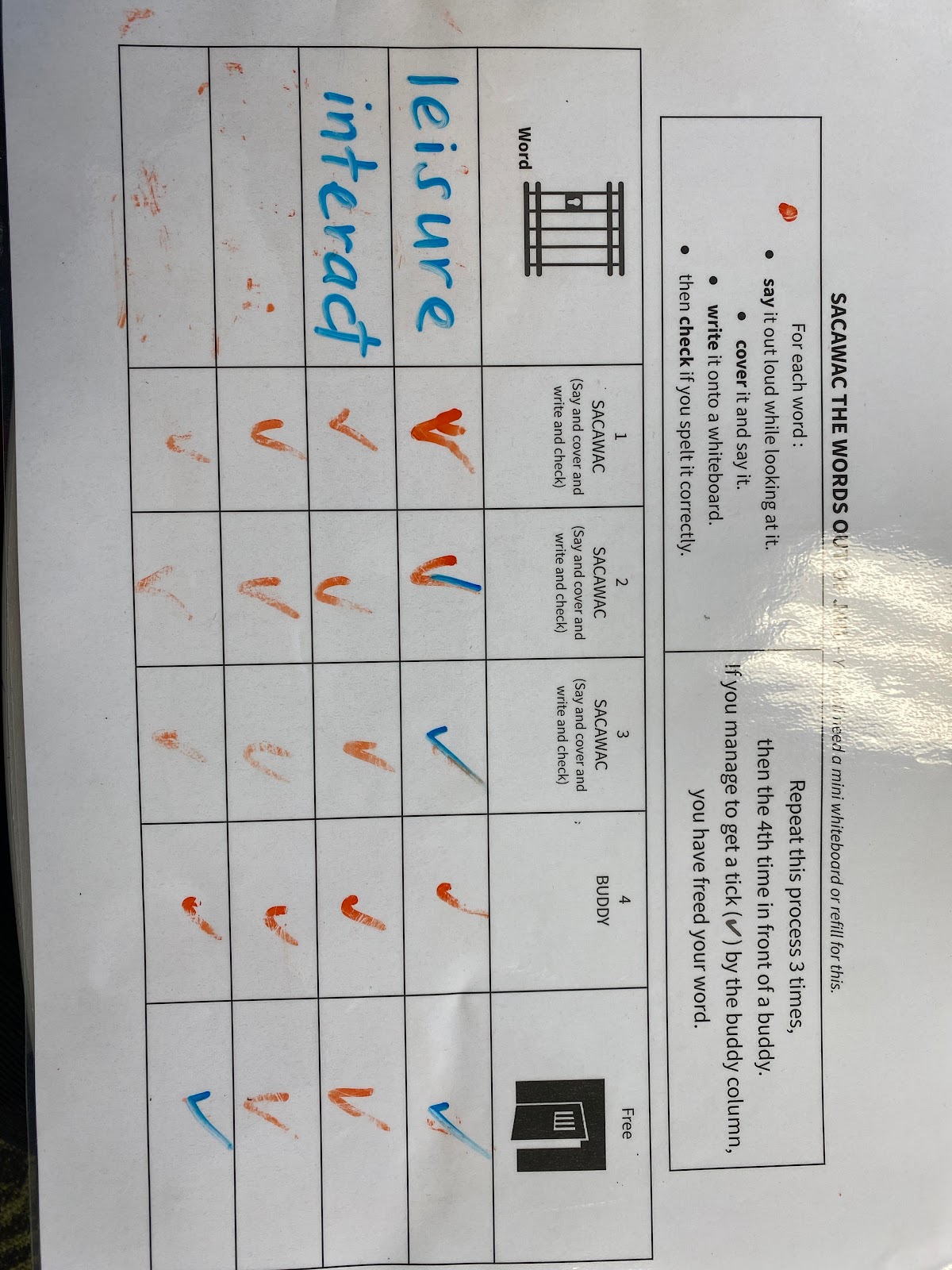
Alongside the tasks for the week, I would write the list of words the students would need to 'SACAWAC.'  You can click here to read more about SACAWAC.  At the start of a guided reading session I'd sometimes get the group to make predictions about the text based only on the word list.  As a result of the SACAWAC activity, students began challenging me to test their spelling ability.  From this, our reading programme grew to include a spelling test every second session - after the students had time to SACAWAC the words.  I have made the spelling lists incorporate vocabulary from the texts they read, as well as vocabulary that have similar patterns to words they may come across in their Peter Schonell Spelling Test.  

How the students responded : 

I feel the students have engaged with this approach to teaching word consciousness / kupu hou.  They are eager to participate in SACAWACing words and spelling tests as they feel a sense of ownership over that part of our reading programme.  They have shown they prefer to do their spelling and marking on paper so that is what we have implemented.  After a spelling test, any words the students got wrong - they had the option to continue to SACAWAC those for homework or when they had completed their other work.

What worked : 

Having a physical copy for students to write on.  This proved more effective than students who just copied and pasted ticks into their Google Docs.  Having a different list for each group - this allowed them to become 'experts' at the particular set of words and the students began teaching others the meanings of the words without being prompted.  Some of the vocabulary has also begun to show up in their writing which has been awesome to see.  Having a spelling test the next day also served as a good purpose for them to be doing the SACAWAC activity and sharing their results with them helped build confidence and a desire to do better.

What I could change : 

I could make an actual wall display of all the topical vocabulary instead of just writing it on the whiteboard.  I am yet to try this as I find the turnover between words could be too much for them to feel like they need to memorise.  I could also do more with their results for spelling as at the moment they just receive a certificate for spelling.  At the moment I store their spelling results in my reading workbook where I can see if/how they improve over the weeks.


Monday, September 11, 2023

Teacher Inquiry - Create Tasks Implemented in Reading

Session 8 of the Manaiakalani Reading Programme Intensive (RPI) focused on different types and kinds of opportunities for students to create.  Our homework was to incorporate a type of create task into our reading programme.  Below I have linked (with permission) some of my student's completed create tasks as well as what the teacher / student instructions were for each task.

Text : Changing Matter on Epic.

Here are the instructions students received at the end of the response to text slides

  • CREATE: Create a DLO that shows and explains “Changing Matter”.  Use any information you think is important from the text to guide you.  Your DLO can be an animation, slideshow, or poster.

Kato chose to create an animation of an ice cube melting then evaporating.  Click here to read his blog post.  (Shared with permission.)

Text : Aztec Attack.

Here are the instructions students received at the end of the response to text slides

  • CREATE: Choose a specific scene from the story "Aztec Attack!" that you want to recreate in Google Drawings. This could be the moment when Izquixochitl first spots the approaching men or the village's preparations for battle.

Loa chose to recreate the scene in the story where two parties are at war.  Click here to read his blog post.  (Shared with permission.)

Text : Bright Family on Epic.

Here are the instructions students received at the end of the response to text slides :

  • CREATE: Create your own backdrop of a universe you think they may come across in the next part of the story.  Use the background remover app to insert yourself into that universe.  Use a speech bubble to show what you would be saying in that situation! 

This is an example of a "short" create task that could and was asked to be completed within the 1 hour block.  Click here to read Dito's blog post.  (Shared with permission.)


What went well : 
  • Students enjoyed seeing themselves in their Create tasks.
  • Students appreciated the choice of medium, and were more engaged when they got to choose the format.
What didn't work so well : 
  • Some students work better with more guidance (where they have to decide less) but some maybe needed less guidance in order to feel and be more creative.
  • Some students went on a tangent to the point the task was no longer connected to the task.
What I will change for next time : 
  • For my more advanced groups, I found that I've often left more decisions for the students to make compared to my lower groups where I would scaffold them a bit more.  
  • I will change my Create tasks so each student gets a sufficient range of tighter tasks that they can start and finish in a block, as well as looser tasks they are given a week to finish on their own.  That way the students can achieve completion more often.

Tuesday, May 30, 2023

Teacher Inquiry - RPI Strategies

My teacher inquiry question for this year is : 

Will implementing the RPI strategies have an impact

on reading comprehension? 

This year I am a part of the Manaiakalani Reading Practice Intensive.  It made sense to me for my teacher inquiry question to relate to what I learn and take away from this course.  

When I began planning for my teacher inquiry question, I was first prompted to reflect on the my class' strengths and gaps according to their Term 1 test results and compare it to my own strengths as a teacher.  This was useful to consider which areas I may need to develop and strengthen in my teaching practice.  I chose reading as my area to focus on as it is a cluster and school wide focus to accelerate reading especially.  Here is a link to the document with my reflections that led to the selection of my teacher inquiry question.

Teacher Inquiry - Reading Comprehension

This term, my teaching inquiry continues to focus on improving reading comprehension for my Year 7 and 8 students. Following a recent lesson...