Showing posts with label observation. Show all posts

Wednesday, November 27, 2024

2024 Maths Programme Reflection

This year in LS1, our maths programme focused on building strong foundations in number knowledge and strategies, helping my Year 6 students (aged 10-11) grow in confidence and enthusiasm. While our main goal was to achieve a 1.5x accelerated shift in progress, the true success has been the improvement in basic facts, multiplication skills, and attitudes towards maths.

Key Goals and Focus Areas
Our main goals were:

  • Achieving 1.5x accelerated progress in maths.
  • Reintroducing students to using maths books for their work.
  • Developing a strong foundation in number knowledge and strategies, which are critical to mathematical success.

Although we touched on strand-based topics, the primary focus this year was on core skills in addition, subtraction, multiplication, and division. This focus allowed students to strengthen their understanding and build confidence in the basics, setting them up for future success.

Our Maths Lesson Structure
To ensure students had a consistent and effective learning experience, each lesson followed a clear structure:

  1. Quick Facts Warm-Up: We started with revision of basic facts (addition, subtraction, multiplication, division) and simple key maths terms like ascending and descending. - this was because a lot of the scores on the PAT Maths tests reflected a lack of understanding of mathematical terms.
  2. Teacher Demonstration: I modelled how to solve problems, explaining each step.
  3. Whole Class Practice: The class worked through problems together to build confidence.
  4. Group Practice: Students collaborated in smaller groups to solve problems.
  5. Independent Bookwork: Students applied their learning individually in their maths books.
  6. Create Task: Students used their devices to complete a creative task, such as making a presentation or solving problems digitally.
  7. Blogging: Each student blogged about their work to reflect on their learning.

We marked work together as a class, and students received immediate feedback. For independent tasks, they marked their own work first before I checked it.

Supporting Students Who Need Extra Help
For students who struggled during class or group activities, I provided additional support in small groups. We worked side by side until they gained the confidence to try the work independently. This personalised approach ensured every student had the opportunity to succeed.

Making Maths Fun and Engaging
To make maths enjoyable, we:

  • Gamified basic facts practice with challenges and sticker charts.
  • Scaffolded lessons, giving students creative tasks to apply their knowledge after mastering the basics.
  • Designed word problems based on our local community, cultures, and student interests, making learning relatable and meaningful.

How We Measured Progress
I used a combination of assessments to track progress:

  • Quick Facts Scores: Recorded on a spreadsheet to monitor growth.
  • Multiplication Challenges: Students marked their own work, and I verified their progress on a sticker chart.
  • Maths Book Checks: I reviewed all bookwork regularly.
  • Digital Work Reviews: Students linked their tasks to a spreadsheet, which I checked online.
  • Standardised Assessments: PAT Maths, IKAN, GloSS, and JAM were used to assess progress across key areas.

Successes and Reflections
While we didn’t achieve the 1.5x accelerated shift we aimed for, our students made significant progress:

  • Improved confidence in multiplication and basic facts.
  • Better attitudes towards maths, with many overcoming initial reluctance.
  • Noticeable improvements in PAT Maths scores.

The programme was a success in many ways, and I’m proud of the strides LS1 made this year. Moving forward, I plan to continue prioritising number knowledge and basic facts, as these are crucial to students’ mathematical development.

Thursday, September 26, 2024

Equivalent Fractions - Class on Air Observation


This week, I observed Rebecca Henderson from St Francis of Assisi School teach a Year 7/8 maths lesson on equivalent fractions. I did this by accessing the Manaiakalani Class on Air website. The focus was on changing fractions to have the same denominator and applying this understanding to problem-solving tasks.

What I Liked :

  • Direct Instruction: The class unpacked key terms such as numerator, denominator, and equivalence. Students practised finding a common denominator and changing fractions into equivalent fractions.
  • Learn Task: Students worked through fraction problems, either individually or with a buddy, and used tools like Mathigon to represent their learning visually.
  • Create Task: Students created videos using the Screencast app or Google Slides to explain their understanding, then shared their work on their blogs.

Students collaborated effectively, using clear mathematical vocabulary and explanations during discussions. By the end, they confidently identified common denominators and ordered fractions on a number line.

My Takeaways : 

  • Visual tools like Mathigon help students grasp abstract concepts.
  • Collaborative tasks encourage deeper understanding and effective communication.
  • Including creative tasks like video-making boosts engagement.
  • Managing classroom devices can be tricky but rewarding when done well.

This lesson showed me how to blend direct teaching with hands-on and creative activities to make maths lessons more engaging and interactive.

Thank you Rebecca for sharing your mahi for us to learn from!

Click here to see the Class on Air lesson I observed.

Sunday, March 24, 2024

The Code - Observation


As part of our whole school literacy programme, each classroom is to spend time teaching The Code (spelling programme) every day.  In today's observation of The Code spelling program, I had the opportunity to observe my team leader and BT mentor Robyn Anderson, lead a captivating session on phonics, focusing on the "ea" sound. Robyn's instructional approach was not only engaging but also informative, providing valuable insights that I can apply to my own teaching practice.

She kicked off the session with a concise overview of The Code, ensuring that students grasped the program's purpose and structure. As she moved into the sound focus, "ea," she integrated real-life examples, fostering a deeper understanding among students. This approach resonated with me as it emphasised the importance of connecting phonetic concepts to students' everyday experiences, making learning more meaningful.

I noted her emphasis on differentiating between long and short vowel sounds. As a senior teacher, I am glad to have had this refresh on phonics as it has been a few years since I've taught a lesson on phonics.  Through interactive discussions and quick quizzes, Robyn encouraged student participation and guided them in discerning the nuances between these sound patterns. I found this approach particularly effective and plan to incorporate similar activities into my own lessons to reinforce phonetic concepts.

Throughout the session, she employed a variety of engaging activities, including partner discussions, mini-challenges, and quick tests, to reinforce learning. Her use of the whiteboard as a visual aid and incorporation of physical movement kept students actively engaged and focused. This multimodal approach inspired me to explore different ways of facilitating learning experiences that cater to diverse learning styles in my own classroom.

As the session concluded with a reflective discussion, I appreciated Robyn's efforts to ensure that students understood key concepts and could apply them independently. This reflective aspect reinforced the importance of ongoing assessment and feedback in the learning process. Moving forward, I plan to incorporate similar reflective practices into my teaching to promote student ownership of learning.

Overall, Robyn's teaching approach highlighted the importance of incorporating real-life contexts, promoting student engagement, and fostering a supportive learning environment. I am eager to apply the strategies and insights gained from this observation to inform my own planning and enhance the learning experiences of my students. 

Tuesday, June 27, 2023

Austin's Butterfly - Feedback and Feedforward

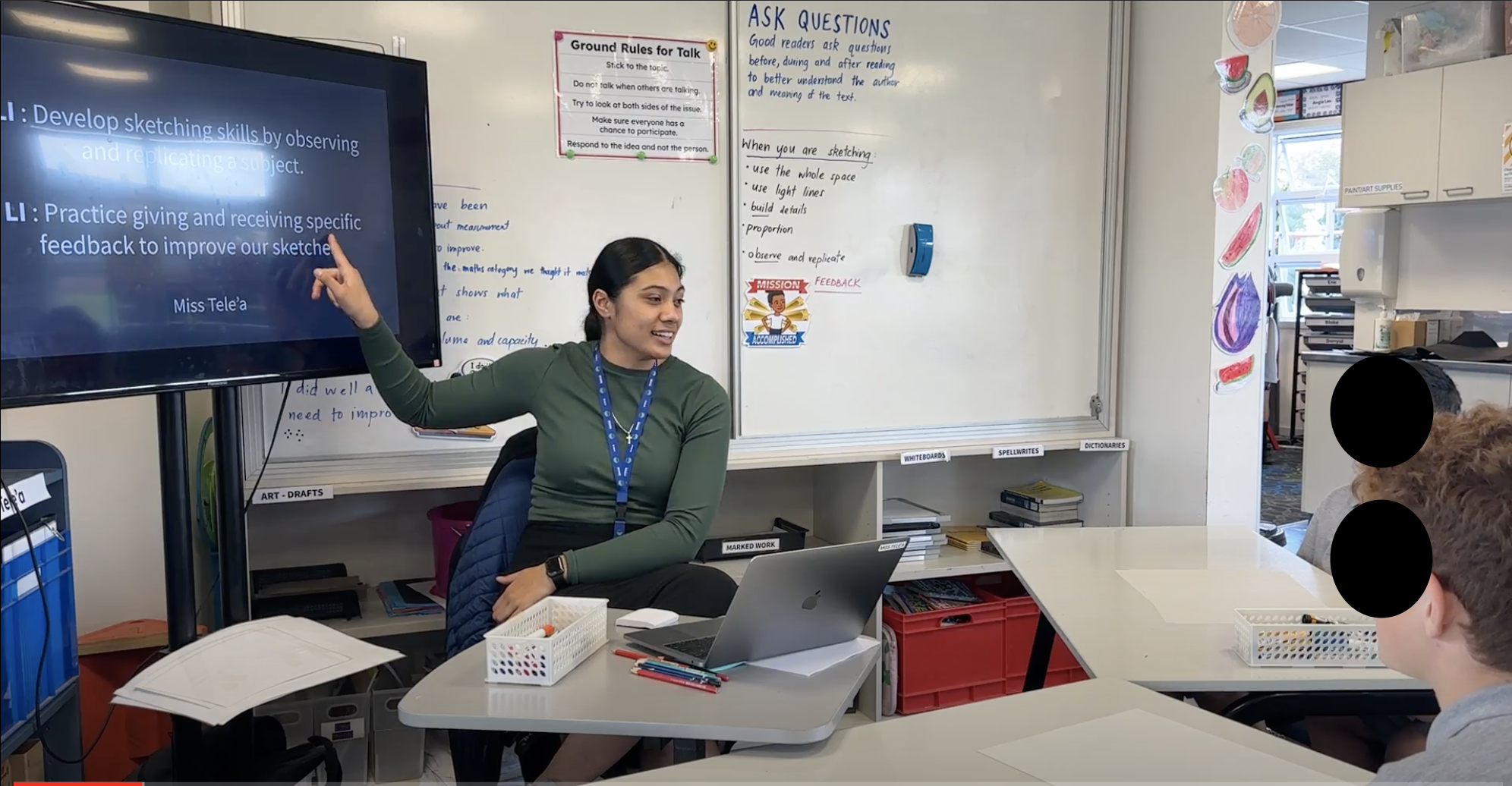
 Recently I conducted the first part of an art lesson with 3 of my target students. Our focus was on developing sketching skills through the use of specific feedback.  I modelled this lesson after being shown "Austin's Butterfly" by my mentor teacher.  This was very useful having something to watch and draw from when creating my own lesson for my akongā.  Reflecting on my own notes and the feedback from my mentor who observed the lesson, means I can gain valuable insights into the effectiveness of my instructional strategies.


To begin the lesson, I reminded the students about the importance of following our ground rules for respectful conversation, which were prominently displayed. This served as a helpful reference point throughout the lesson.

  • The learning intentions (LI) for the lesson were twofold: to develop sketching skills by observing and replicating a subject, and to practice giving and receiving specific feedback to improve our sketches. I made sure to clarify these intentions at the outset and provided the necessary materials such as A5 paper, pencils, and a reference image of a monarch butterfly.
  • To engage the students in a discussion about feedback, I asked them what it meant when someone gives their "2 cents" in a conversation. This question prompted pairs of students to share their thoughts and then share their responses with the whole class. I captured their ideas on the board, ensuring that their voices were heard and acknowledged.
  • The main video activity involved watching "Austin's Butterfly," a story about a first-grade student who receives feedback on his artwork. I challenged the students to pay attention to what effective feedback looks like during the video. They used newsprint to record their observations.
  • After watching the video, I guided the students through a sketching exercise. I encouraged them to draw from memory, emphasising the importance of using the whole space, observing carefully, using light lines, building details, and considering proportion. I provided a visual example to illustrate the concept of proportion.
  • To co-construct success criteria for effective feedback in art, I asked the students what they believed promoted growth and improvement. Their answers were transcribed on the board. We concluded that feedback should be specific, respectful, and actionable.
  • The lesson concluded with a feedback activity, where students were assigned partners and given sticky notes to provide feedback to each other. I encouraged them to use the sentence frame, "I really like how you ________. Next time, you could try ________ to make it even better." This structure aimed to promote constructive and supportive feedback.

In retrospect, I acknowledge the strengths and areas for improvement in the lesson. The engagement level was high, and the use of visual aids, such as the video and example sketches, enhanced the students' understanding. However, I could have provided more visual prompts throughout the lesson, such as displaying the monarch butterfly image earlier.

In future lessons, I will make more deliberate connections to prior learning, and make sure that new concepts can be connected to the students' existing knowledge.  One thing we noticed was that I talked "about" feeding forward, but I never once actually referred to it as "feedforward." This comes down to being explicit with the words I use when teaching a group.  I need to use the words I want my students to use.  Additionally, I will try to use terms such as "learning intention" and "success criteria" more explicitly to enhance student understanding.

Overall, the feedback from my mentor and my own reflections will guide me in refining my teaching strategies. I appreciate the suggestions to make feedback a weekly focus and to continually seek examples of how I can improve my lessons. By implementing these recommendations, I am confident that I will create even more meaningful and effective learning experiences for my akonga.

Sunflower Artwork : Chalk, Crayon and Dye

At our weekly staff meetings, our principal, Richard, has been leading engaging art sessions.  Drawing inspiration from Vincent van Gogh's iconic paintings and captivating images, we delved into the world of sunflowers, where we learned to create artworks using crayons, chalk, and dye.  Richard modelled how we might introduce this lesson to our own students.

To start, Richard displayed various sunflower paintings and images to immerse us in the intricacies of these flowers. We also incorporated reading tasks linked to Vincent van Gogh (VVG) to deepen our understanding of his artistic style and vision.  

To deepen our students' connection with sunflowers, Richard suggested buying fake sunflowers from a local shop, and allowing the kids to closely examine them. This hands-on experience would give them a chance to appreciate the delicate petals, explore the seeds, and even discover links between sunflowers and things like the oil they produce.

For the art process, Richard advised starting with sketching using coloured chalk, focusing on capturing the essence rather than intricate details. The kids could then use RETSOL crayons to colour in the leaves and stem with solid blocks of colour, experimenting with complementary colours for the background. Adding dye would create stunning black lines as the chalk absorbed the colour.

Ngā mihi Richard for our art lessons this term.


Monday, June 12, 2023

What We Share - Cybersmart Facilitation

As a BT, I have the opportunity to observe a lesson on cyber safety and responsible online behaviour once a week.  This week I observed a lesson led by Matt Goodwin, which focused on the topic of public versus private information.  Here is a link to my Cybersmart page that is facilitated by Matt.

LI : To know the difference between public and private information on the internet.


The lesson began with a thought-provoking video that underscored the potential consequences of sharing personal information online. This captured my students' attention and set the stage for the lesson.

  • Matt facilitated a whole-class discussion on the concept of a digital footprint, encouraging students to share their thoughts and insights. This discussion deepened their understanding of the long-lasting impact of online actions, something we also discussed in the previous lesson.
  • Students were provided with a template to categorise personal information as either public or private. Matt guided them through the process, ensuring they understood the significance of each category.
  • Matt provided individual support to students during the activity, encouraging critical thinking and assisting them in making informed decisions about the classification of personal information. This personalised approach fostered a sense of ownership and responsibility.


Students were prompted to reflect on their own online presence and evaluate the need for privacy.  Throughout the lesson, Matt emphasised the need to think before sharing information online and stressed the personal responsibility each student holds in maintaining their cyber safety.

Some key takeaways from this observation include:

  • The significance of engaging students through multimedia resources to create meaningful connections.
  • The power of whole-class discussions in fostering a deeper understanding of digital footprints and their implications.
  • The effectiveness of providing students with a structured template to categorise information.
  • The value of individual support and guidance to encourage critical thinking and responsible decision-making.
  • The need for students to reflect on their own online presence and consider the impact of their actions.
Here is a link to the template the students were working on.
Ngā mihi Matt for your time and facilitation.

Mood and Atmosphere - Observation

This week I had the opportunity to observe my mentor teacher Robyn model a lesson.  The focus was on introducing mood and atmosphere using writing frames. She carried this lesson out with my target reading group. Robyn's deliberate acts of teaching provided great insight for me in regards to how I can effectively explore the mood and atmosphere of a story using structured writing frames. (Robyn is referred to as T or RA in my notes.)

T introduced the concepts of mood and atmosphere by providing clear definitions, ensuring that all students had a solid understanding of the terms.  She then prompted students to think of their favourite story and examples of mood and atmosphere within it.  To help the students grasp the concept of mood, T used the analogy of Red Riding Hood.  Students discussed Red's mood when she carried baskets of muffins and when she encountered the wolf.  By connecting a story the students were familiar with, T made the students realise that the author skill-fully conveyed the character's mood without explicitly stating it.  T encouraged the students to think beyond the explicit text and consider the more subtle cues that shape the mood.

T provided a writing frame and guided students through describing the mood and atmosphere using an image.  Students experimented with words and phrases, sharing their ideas and collaboratively building vocabulary.  The writing frame helped students focus on inferring and visualising details without relying on the picture alone.

T read aloud the collective writing, making adjustments based on students' suggestions.  She emphasised expressive reading to convey the desired mood and atmosphere.  Students actively listened and evaluated the created mood, leading to discussions and reflections on their interpretations.

Robyn's intentional teaching strategies fostered student engagement and comprehension in exploring mood and atmosphere. By using an image, writing frames, collaborative discussions, and quick reflections, students were able to analyse the text independently, inferring and visualising the intended mood and atmosphere. This approach empowered students to develop their descriptive writing skills and deepen their overall understanding of literature.  I am excited to implement these strategies with my own reading group.

Key takeaways : 
  • Instead of overwhelming students with a list of words to memorise, Robyn encouraged students to discover new vocabulary through context and discussion.
  • I most enjoyed how vocabulary development was integrated into the lesson using images and examples to reinforce word meanings.
  • Students were encouraged to take risks in their writing, and were told not to worry about spelling which in turn placed even more emphasis on creative expression.
  • By "gifting" vocabulary to the students, they were encouraged to explore more vocabulary using Word Hippo.
Ngā mihi Robyn for your lesson and your time.
Here is one of my student's blog posts from after the session (shared with permission.)


Tuesday, May 30, 2023

24 Hour Digital Footprint - Cybersmart Facilitation

During this week's Cybersmart session, I observed Mr Matt Goodwin teach a lesson about understanding the concept of a "digital footprint." The learning intention for the lesson was to help tamariki (students) comprehend the significance of their online presence.

The lesson began with watching a video, followed by a class discussion on the idea of a digital footprint. Matt drew upon everyday analogies, such as footprints in the sand or walking through mud and then entering a house, to help the akonga connect to this idea that their online actions have an impact. He also connected the concept to sponsorships and advertisements that people want to see, emphasising the importance of promoting ourselves in a positive way when we blog or share our work.  I found that the analogies especially engaged the boys in this group.

Matt made effective use of getting students to "45" their screens between giving instructions and modelling.  I realised I tend to forget to model things like making a copy of a document or "45ing" my screen because I assume the students will do so without being told to, so that is something I will be keeping in mind going forward.

The tamariki were instructed to open their browsing history from the past 24 hours using the shortcut Ctrl + H.  This allowed them to reflect on what their online activities revealed about them. They were provided with a template to make a copy of, they then began the task of putting icons to represent the different websites they had been on in the last 24 hours.

I feel that this lesson invited my akonga to become active participants in their online lives. It also highlighted the significance of understanding and managing our digital footprints. By incorporating relatable analogies, encouraging self-reflection, and promoting positive online presence, Matt reminded the tamariki of the tools they can use to navigate the digital world responsibly. This lesson will become one I can refer back to when talking about cyber safety to the children.

Here are some links to students' blog posts after the session :

Monday, March 13, 2023

Smart Footprint : Cybersmart Facilitation

In today's Manaiakalani Cybersmart facilitation, I observed Mr. Matt Goodwin teach a lesson with a focus on having a 'Smart Footprint', which is a critical concept in today's digital age. The lesson centred around managing one's online presence, ensuring that students understood the importance of how they present themselves online.  The purpose of today's student task was to cover some of the more technical and design aspects in Google Draw to create things like a poster. My students learned the importance of managing their online presence and how it can affect their real-life reputation as well as important basic skill in using Google Draw to create DLO's.

MG began the lesson by sharing a poster he'd made of himself with vectors of things 'about' him. He then asked the class what they had learned about him from the pictures shown in the presentation. This opened up a discussion on how the online presence of a person could shape their image in real life.

The teacher stressed the importance of being careful about what students put online, saying, "I'm not going to put that on the internet" when discussing personal information.

My key takeaways from the facilitation :
  • Going through things like :
    • ...making a new document in a folder
    • how to make an image bigger without distorting it - teaching them to use the shift key to keep size consistent...
  • is beneficial for both the learners and the kaiako - we often assume at this age that most of them know already.
  • MG demonstrated how things your learners should know in order to complete a task online can be made into teaching points when introducing the lesson or doing a guided session - for example how to change a font etc. (Things that may be often overlooked.)
By using Google Drawing, my students were able to practice their Google Drawing skills, as well as practice concepts of leaving a 'smart footprint'. These skills will be valuable for students as they navigate the online world, and my students definitely enjoyed learning how to create using the colour matcher, Remove.bg, and Google Drawing tools. Ngā mihi Mr Goodwin!

If you would like to see this lesson and previous lessons on our class site, you can click here.

BT Talanoa - PROBE

As a BT, it is very important to me that I learn effective techniques for assessing student learning. During my Week 6 PRT release I had the opportunity to observe two different teachers carry out two different types of reading assessments - a PROBE test, and a running record.


PROBE stands for : Pre-Reading Observation Behaviour and Evaluation.

Here are my key takeaways from my observation of a teacher carrying out a PROBE assessment :

(T = Teacher, S = Student)

1. Start with a summary :

  • T began by asking S to tell T what the story was about in T's own words.
  • This helped T to get a rough idea of his comprehension level before diving into the actual detailed questions from the PROBE book.
2. Questions in a PROBE test can be interpreted as open-ended.
  • The set questions required S to provide a detailed response using evidence from the text.
  • T writes down word for word what student says.
3. Verify vocabulary.
For the vocabulary question, T pointed to where it was underlined in the story and asked them to explain it.  This helped T to verify that he was comprehending the text accurately.
4. Correct misunderstanding.
  • When S made a mistake, T corrected him by referencing the text and pointing out where he had misunderstood.
  • T made a note of the mistake at the bottom of the assessment sheet as a reminder to herself to give that topic to the S as a goal to work on in the future.
5. Co-construct goals : 
  • T co-constructed a goal for reading with S, and explained the immediate next steps to S.
  • T also made sure S was aware of his learning goals.
6. Use the assessment results.
  • T used the one mistake the S had made to let him know what he was currently working on and what he would be doing in class in the future.
  • T also made sure to give S access to his PAT results and explained what he needed to work on.
Overall, I found the PROBE assessment to be an effective tool for assessing student learning.  I learned a lot from observing two different teacher's approaches and will definitely incorporate these techniques into my own teaching practice.  I have learnt that by using the different techniques I observed, teachers can create a more effective and personalised learning experience for their students.

Tuesday, February 21, 2023

Kawa of Care : Cybersmart Facilitation

Monday mornings in my classroom see Mr Matt Goodwin facilitating a Cybersmart session with my students.  This week's was the first of the lessons to happen due to the state of Aotearoa in the last two weeks.  The lesson focused on the Kawa of Care, specifically in helping the students to connect with the Kawa of Care as a document and an agreement that they have a stake in.

The Kawa of Care is an agreement between students, parents and schools in the Manaiakalani Cluster to ensure the best care and responsibility of the device is exercised during each student's time in the Manaiakalani Programme.  If you would like to know more about Manaiakalani's Kawa of Care you can click here.

I was interested to see how my Year 4 and 5 students who are 'brand new' to chromebooks would respond to content from the Kawa of Care.  They were all able to connect the dots after Mr Goodwin made connections to simpler things they would have all experienced - (eg. paying someone to mow your lawns - contract - 2 people needing to hold up their end). I know that the lesson also served as a well needed reminder to some of the 'veteran' Year 5's in my group.

As a beginning teacher of digital learners in the Manaiakalani cluster, my takeaways were : 

  • The Kawa of Care is something that is beneficial to reference in things like Class Treaties when starting the year.  I have added this into our working classroom set of rules.
  •  When I talk about chromebooks in class, I can refer to the Kawa of Care to help use the language to create a shared understanding of it.
  • What I hope for my students is that they can take ownership of their chromebooks and look after them in a way that upholds what they and their whanau agreed to in the Kawa of Care.
Some of my student's takeaways were :
  • Beginning to understand that using a chromebook at school is a right and a responsibility that their whanau have agreed to, that their schools has agreed to, and therefore something they need to agree to honour as well as their part.
  • Their "part" is to follow the Kawa of Care.
Here is the DLO the students worked through with MG.

MG provided a template that has been designed to help break down the Kawa of Care document into a basic reading response style task.  The template is what is linked at the top of this blog post.  My notes from the session are here. 

If you would like to know more about Manaiakalani's Cybersmart programme you can click here.

Teacher Inquiry - Reading Comprehension

This term, my teaching inquiry continues to focus on improving reading comprehension for my Year 7 and 8 students. Following a recent lesson...