Friday, May 10, 2024

Term 2 2024 - Goal

 Term 2 Goal: Improve Student Writing Across the Curriculum

This term, my focus is on improving my students' writing across all subjects. Writing is such an important skill for Year 6 students, and I want them to feel confident expressing their ideas clearly and effectively, no matter the subject.

To achieve this, I plan to integrate more structured writing activities into different areas of the curriculum. For example, students will write recounts in science, persuasive pieces in social studies, and reflections during inquiry learning. I’ll be using shared and guided writing to model the writing process and show students how to plan, draft, and edit their work step-by-step.

Feedback is another big focus this term. I’ll provide targeted feedback to help students improve specific areas of their writing, while also introducing peer feedback so they can support and learn from each other. My hope is that by the end of the term, they’ll see writing as not just a task, but a way to share their voice and ideas confidently across all areas of their learning.

Thursday, April 11, 2024

Class on Air Observation

Class on Air Observation Notes

This week, I observed Kelsey from Pt England School teach a Year 5-6 reading lesson through Manaiakalani's Class on Air. The focus was on the text Journey on the Sea, with an emphasis on water safety and understanding the author’s purpose.

Lesson Highlights

  • Before Reading: The class brainstormed water safety ideas after watching a video, connecting these to prior swimming lessons.
  • Guided Reading: Students used Chromebooks to read the text, answer questions, and infer meaning.
  • After Reading: They worked in groups to review the text, create water safety GIFs, and share their work on blogs.

The lesson connected to real-life experiences, making it engaging and meaningful. Students built on prior learning about the author’s purpose, and even quieter students felt encouraged to participate. Kelsey shared in her reflection that using Chromebooks instead of journals was a distraction for some students—a challenge I can relate to in my own teaching.

Takeaways : 

  • Real-life connections keep students engaged.
  • Being flexible is key when things don’t go to plan.
  • Encouraging quiet students builds their confidence.
  • Devices are great but need careful management to minimise distractions.

This lesson inspired me to use creative tasks and real-world links in my teaching while staying mindful of potential distractions.

If you would like to watch the Class on Air Lesson I have written about, click here.

Thank you Kelsey for sharing your mahi for us to learn from!

Thursday, April 4, 2024

Pause Breathe Smile

I’ve recently completed the Pause Breathe Smile (PBS) mindfulness programme, and it has been an great experience. Through the six lessons, I gained new tools for calmness, focus, and self-awareness. These lessons have not only helped me personally but also boosted my confidence in leading mindfulness practices with my class.

Pause Breathe Smile is rooted in New Zealand’s identity and is deeply connected to Te Whare Tapa Whā, a Māori model of wellbeing. This has made the programme even more meaningful, as it ties in with Aotearoa’s culture and can be used in both mainstream and Māori immersion classrooms. Since 2015, PBS has been developed with experts to create resources in te reo Māori, including updated handbooks, audio guides, and videos for mindfulness exercises.


What I Learned :

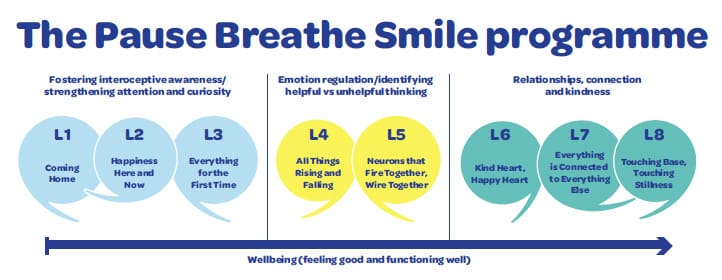
The PBS programme consists of six lessons, each designed to build mindfulness and awareness. Each lesson begins and ends with a karakia (prayer) to help centre the mind. After completing the lessons, I feel more confident in applying mindfulness in my own life and teaching it to my students.

  1. Lesson 1: Introduction to Mindfulness
    The first lesson taught me the basics of mindfulness and the importance of mindful breathing. It introduced me to the first foundation of mindfulness—awareness of my body.

  2. Lesson 2: Finding Calm with Breath and Body Awareness
    This lesson helped me understand how to use my breath to activate calmness in my body. It deepened my awareness of how my body responds to stress and how to calm it.

  3. Lesson 3: Gratitude and Beginner’s Mind
    I learned how practising gratitude can support mindfulness and how to adopt a “Beginner’s Mind,” which means staying open, curious, and non-judgmental.

  4. Lesson 4: Awareness of Feelings
    This lesson taught me how to be more aware of my emotions and how to stay present, even when I feel upset or distracted. It helped me develop better emotional regulation.

  5. Lesson 5: Understanding and Regulating Emotions
    In this lesson, I learned how to better understand my emotions and moods and how to use mindfulness to self-regulate and stay calm in difficult situations.

  6. Lesson 6: Loving-Kindness and Awareness of Thoughts
    The final lesson introduced loving-kindness and the power of being compassionate towards myself and others. I also learned how to become more aware of my thoughts and how to manage negative thinking.

Completing these six lessons has given me the tools and knowledge I need to confidently teach Pause Breathe Smile to my students. I now feel ready to lead mindfulness exercises in the classroom and help my students develop the same calmness, focus, and emotional awareness that I have gained. By completing the course myself, I have a deeper understanding of the practices, which makes me feel confident in guiding my class through them.

As I continue with my own mindfulness practice, I’ll keep using the guided exercises available from the course. I look forward to sharing them with my students so they can benefit too.  I’m excited to see how it can support their wellbeing and growth.

Thank you to the Pause Breathe Smile for the time you took to teach myself and the other teachers.

Wednesday, April 3, 2024

2024 Teacher Inquiry Question

At the start of this year, I decided to focus my inquiry on improving spelling and phonological awareness in my Year 6 class. My goal is to explore how embedding The Code into my practice can increase students' word knowledge, particularly for those who are at risk or working below expected levels.

My inquiry question is:
"How can embedding The Code in my practice help increase students' spelling and phonological awareness, particularly for those who are below expected levels or at risk?" My teacher inquiry question links to Manaiakalani goals of: improving teacher practice, and making 1.5 Years progress inside a year.

I chose this focus because spelling and phonological awareness are foundational to literacy development. Many of my students, particularly those who speak English as a second language or face other challenges, need additional support in these areas. By improving their understanding of sounds and word structures, I hope to help them become more confident and competent in both their reading and writing.

To begin this inquiry, I have collected data on my students' spelling progress, which includes their spelling test scores as well as additional details such as their age, ethnicity, and student feedback (student voice). Below is a summary table of this data for my target group:

This inquiry is already reinforcing the importance of revisiting essential skills that may not always be fully developed by the time students reach senior school. It's clear that reinforcing these foundational concepts will benefit all learners, particularly those with gaps in their phonological awareness and spelling.

Sunday, March 24, 2024

The Code - Observation


As part of our whole school literacy programme, each classroom is to spend time teaching The Code (spelling programme) every day.  In today's observation of The Code spelling program, I had the opportunity to observe my team leader and BT mentor Robyn Anderson, lead a captivating session on phonics, focusing on the "ea" sound. Robyn's instructional approach was not only engaging but also informative, providing valuable insights that I can apply to my own teaching practice.

She kicked off the session with a concise overview of The Code, ensuring that students grasped the program's purpose and structure. As she moved into the sound focus, "ea," she integrated real-life examples, fostering a deeper understanding among students. This approach resonated with me as it emphasised the importance of connecting phonetic concepts to students' everyday experiences, making learning more meaningful.

I noted her emphasis on differentiating between long and short vowel sounds. As a senior teacher, I am glad to have had this refresh on phonics as it has been a few years since I've taught a lesson on phonics.  Through interactive discussions and quick quizzes, Robyn encouraged student participation and guided them in discerning the nuances between these sound patterns. I found this approach particularly effective and plan to incorporate similar activities into my own lessons to reinforce phonetic concepts.

Throughout the session, she employed a variety of engaging activities, including partner discussions, mini-challenges, and quick tests, to reinforce learning. Her use of the whiteboard as a visual aid and incorporation of physical movement kept students actively engaged and focused. This multimodal approach inspired me to explore different ways of facilitating learning experiences that cater to diverse learning styles in my own classroom.

As the session concluded with a reflective discussion, I appreciated Robyn's efforts to ensure that students understood key concepts and could apply them independently. This reflective aspect reinforced the importance of ongoing assessment and feedback in the learning process. Moving forward, I plan to incorporate similar reflective practices into my teaching to promote student ownership of learning.

Overall, Robyn's teaching approach highlighted the importance of incorporating real-life contexts, promoting student engagement, and fostering a supportive learning environment. I am eager to apply the strategies and insights gained from this observation to inform my own planning and enhance the learning experiences of my students. 

Monday, February 26, 2024

Term 1 2024 Goal & Reflection


My Term 1 Goal:
Strengthen Class Connections – Build a positive and inclusive classroom culture by fostering strong relationships with students, encouraging teamwork, and setting clear expectations for behaviour and learning.

Why : As we begin the school year, it's important to me to build a foundation of trust and community within my classroom. Strong connections among students first of all create a safe and supportive learning environment, which is probably the most successful thing I could achieve as a teacher.  It also encourages collaboration, and boosts engagement and academic success. I want each student to feel valued, heard, and part of a team, where they can express themselves without fear of judgment.

What I Plan to Do: To achieve this, I am planning to begin the term with team-building activities that help the students get to know each other better.  We are also quite blessed in that this will be our second year together as a class as well as with me as their teacher - so I have an advantage in that I know a lot about my students already.  We will do low stakes icebreakers, group games, and share personal stories to help everyone find common ground. I will also introduce clear and consistent classroom expectations around respect, responsibility, and kindness. As the term progresses, I hope to remember to continue to reinforce these values through daily interactions and class discussions, making sure students know they have a voice in shaping our learning space.

EDITED WEEK 10 TERM 1 2024*

Reflecting on my Term 1 goal of strengthening class connections, I’m really happy with how things have gone. The students are more confident in sharing their ideas and have started seeing learning as something fun rather than something they have to do. It’s great to see them working with classmates they wouldn’t normally choose, which shows they’re starting to connect more with everyone.

Our reward system has also worked well since we switched from individual rewards to group-based ones. The table groups are more motivated, and they’re really putting in more effort. The class voting on rewards has helped them feel more involved and invested in the process. Also, the allocated seating has been better for focus and has helped students work with different people.

Overall, I’m happy with the progress we’ve made in building a positive and supportive classroom environment. I’m looking forward to seeing how these connections grow in the next term.

Thursday, February 22, 2024

Same But Different - 2024

As an educator, the classroom is not merely a space for lessons but an environment that plays a pivotal role in shaping students' experiences. Last year, I found myself in a MLE space, sharing a class of 60 students with another teacher spanning across years 4, 5, and 6. This year, the transition to teaching only Year 6 students has presented a unique opportunity to redefine and revamp the learning space to better cater to their specific needs.

One of the first challenges was to make the space feel new for the returning Year 6 students. The classroom layout plays an important role in fostering a conducive learning environment. I divided the space into two zones to cater to different aspects of our daily routine. One side is dedicated to formal learning, with organised desks and a clear focal point for lessons. The other side now serves as a flexible breakout space, providing a comfortable setting for roll calls, whole class discussions, and things that require more space such as mindfulness or drama.  It also serves as a space students "work towards" sitting in for independent tasks.

Beyond the physical transformation of the space, it has been equally important for me to communicate a shift in expectations and behaviour from last year. While the memories of some less-than-ideal moments lingered, I approached this with a focus on positive change.  During our first day together, I took a moment to address the akonga with sincerity. I expressed my belief in their ability to rise above past challenges and assured them that this year was a fresh start for everyone. By acknowledging the past without dwelling on it, I hope I have set a tone of optimism and understanding. The physical changes to the space served as a tangible reminder that this is indeed a new year.

To instill a sense of belonging and ownership among the students, we got to work straight away - displaying their projects, and artwork.  It has not only boosted their confidence but also created a positive and collaborative atmosphere where everyone feels valued.  Expecting manuhiri in Week 3 was a good motivator for this also.

Pictured is my former principal Mr Burt and I during a Manaiakalani Principals' Visit to my kura.  I took great pride in welcoming him and the other manuhiri to our space - and I was especially proud to see my students taking ownership of our class, offering to show our visitors their different mahi around the classroom.

As the year progresses, I hope it becomes evident that my akonga have embraced this new beginning.  I want them to understand that their actions will shape the character of our shared space.  Kia ora 2024!

Teacher Inquiry - Reading Comprehension

This term, my teaching inquiry continues to focus on improving reading comprehension for my Year 7 and 8 students. Following a recent lesson...